





Early last month, the director of a factory manufacturing and installing industrial kitchen equipment in Hoang Mai district (Hanoi) brought a laptop to the office. Bao Son Media with a rather impatient expression: "Let me check for you to see if there are any errors on the website. More than 30 of our main keywords are still in the Top 2 - Top 3 of Google like last year, without dropping a single step. But for some reason, the number of customers clicking on the website and calling to ask for a quote in the last three months has decreased by nearly half. This morning, I tried to use my phone to type in the search to buy an industrial induction cooker and see right at the top of Google, an AI synthetic response box appeared, it summarized all the technical specifications and attached a link to it. The websites of two rival units are ranked in the Top 6 and Top 7!”
The story of the kitchen factory director is not an isolated case. Over the past half a year, when Bao Son's technical team directly reviewed Google Search Console data for more than 120 B2B businesses and retail systems in Vietnam, we noticed an extremely clear behavioral shift: today's customers are no longer patient enough to open 5-7 tabs of long articles to self-filter information like before.
Instead, when a buyer types a question on Google (trigger frame Google AI Overviews at the top of the results page) or ask directly above ChatGPT Search, Perplexity, Gemini, Copilot, the artificial intelligence engine will skim through dozens of web pages in seconds, synthesize a complete answer, and Select only 3 to 5 most trustworthy websites to tag the source (Citation Link). The article below is from the team of experts at Bao Son Media & Trading Co., Ltd. will guide you how Optimize content for AI search In the most practical way, helping businesses' articles not only stay at the top but also be prioritized by AI engines to directly quote them to attract real customers to call.
- Standing in the Top 10 traditions is not necessarily cited by AI: The combined algorithm of Google AI Overviews and ChatGPT does not choose the longest article or the most keyword-stuffed article. It prioritizes pages that have direct answers right under the title, have clear data sheets, and have real-life verifiable data.
- Immediately stop writing "300-word introductory essay" and the 50,000 VND trash article: Articles with meandering openings, re-created from other sites, or using mass-produced AI commands without the business's exclusive information will be completely ignored by AI search filters.
- Focus on entity data and easy-to-extract structures: When the article is presented coherently according to the structure 45 word summary answer + HTML comparison table + Transparent quote + JSON-LD Schema, the likelihood of being chosen by AI as a reference source increases 3 times compared to pure text articles.
Why are articles that are ranked at the top of Google but the content has not been optimized for AI searches still ignored?
Many business owners ask Bao Son to check the status There are many articles but few contacts often wonder: "Your team has hired collaborators to write more than 200 SEO-standard articles. The Yoast SEO light for every article is green, but why when you search on Google AI or ask ChatGPT, you never see your company's name mentioned?"
The reality is that the big language models behind Google AI Overviews, Perplexity or ChatGPT Search do not score articles based on a mechanical keyword density count. When scanning hundreds of websites in Vietnam, we discovered four old writing habits that are causing businesses to lose their position in the AI response box:
Open a roundabout lesson
Customers type and search “How much does it cost to install a 450kg home elevator?”, but the article opens with a half-page defining what an elevator is and when did its history come into being. The AI engine needs straight answers in the first paragraph; If it has to wade through a forest of innocuous words, it will always take data from competitor websites that are written more concisely.
Stir-fried content
Cheap articles often just open the first 3 pages on Google and then rewrite the words differently, or use the ChatGPT command to create dozens of identical general articles. The 2026 search algorithm prioritizes the so-called Information Gain — if your article does not have any parameters, price list or actual experience that is newer than the existing article, AI will immediately remove it.
Confusing presentation
Artificial intelligence absolutely loves reading structured data like tables <table>, bulleted list <ul>, step-by-step process <ol>. If you cram the price quote, technical specifications, and warranty terms into a 15-line paragraph with no breaks, it will be very difficult for the AI crawler to extract it accurately and put it in the summary box.
Faded brand
When users ask AI “Which company provides reputable services in Hanoi?”, AI will compare the brand name, headquarters address, phone number, customer reviews and code Schema JSON-LD across the network. These websites are just for “Price: Contact” and lack of actual author information are rarely recommended by AI as a reputable supplier.
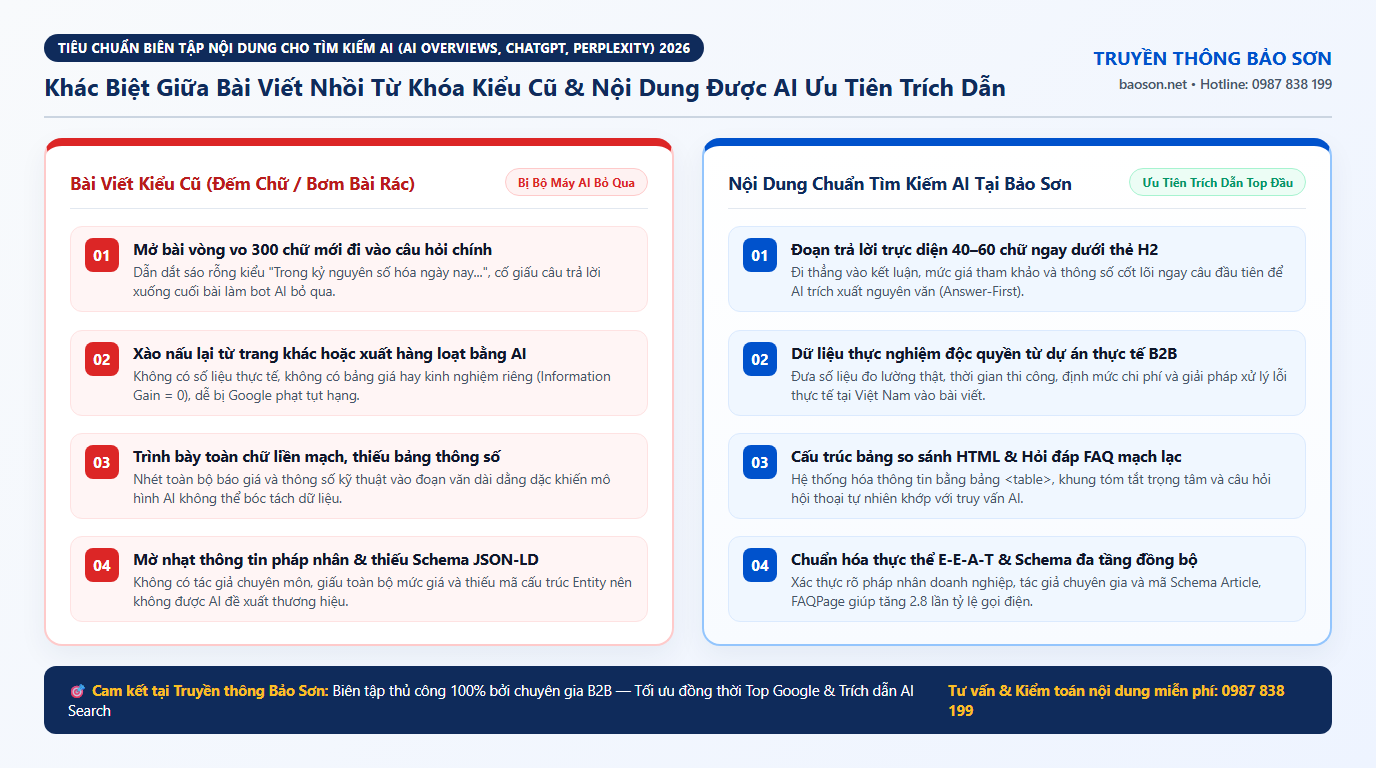
The essential difference between traditional keyword SEO and content optimization for search with AI (GEO / AEO)
For easy visualization without having to remember complicated English terms like Generative Engine Optimization (GEO) good Answer Engine Optimization (AEO), you just need to understand simply as follows: Traditional SEO is a race to bring your website link to the first 10 positions on the results page; still Optimize content for AI search is how when AI reads those 10 pages, it Choose the right data, words, and your company name to cite the answer in a prominent position.
Below is the actual comparison table deployed by the team website SEO services by Bao Son Media compiled from real-life projects in 2026:
| Evaluation Criteria | Optimizing Content for AI Search (2026 Standard) | How to Write Traditional SEO Articles Old Style |
|---|---|---|
| Core goal | Okay Direct quote (Cited Source) in the answer box Google AI Overviews, ChatGPT, Perplexity and attract customers who already have high purchasing needs. | Push the main keyword to page 1 of Google, get as many clicks to find out general information as possible. |
| How to start an article and H2 sections | Apply principles Answer first – Explain later (Answer-First): Immediately provide conclusions, prices or specific numbers in the first 40 - 60 words right below each title. | Open the article ramblingly, keeping the answer secret until the end to try to keep readers on the page longer. |
| Data presentation structure | Break down information by parameter comparison table <table>, key summary framework, step-by-step checklist and practical FAQ section. |
Write long paragraphs of text one after another, awkwardly inserting main keywords over and over again. |
| Actual Evidence (E-E-A-T) | There are real measurement data, actual project photos, names of experts responsible for expertise and transparent corporate legal information. | Using illustrations that are widely downloaded online, the general content is the same for everyone who writes. |
| Quality of customer calls | Customers have finished reading AI's summary and clicked on the source link to See detailed quote or contact to order now (order closing rate is 2.5 - 3 times higher). | The amount of traffic may be high but the bounce rate is high because readers have to work hard to filter the information themselves. |
Five techniques to optimize content for search with AI to help articles be prioritized for citation by Google and ChatGPT
There's no need to destroy and rebuild hundreds of old articles on the web. According to Google Search Central's official guide to AI Overviews, generative search systems prioritize pages that have a clear structure, authentic information, and that directly satisfy the query intent. When receiving content upgrades for customers in Hanoi and Ho Chi Minh City, the editorial team of Bao Son Media Always apply the following five focus editing techniques to the top 20 most important sales articles:
Step One — Place a “50 Word Direct Answer Block” directly below each H2 heading
AI search models work by cutting short paragraphs (Passage Retrieval) to fit into the answer frame. So right below each title tag <h2>, write a short paragraph about approx 40 to 60 words Answer directly to the question of that title, absolutely do not use cumbersome linking words.
For example, if title <h2> To be “What is the cost of designing a business website with SEO standards in 2026?”, the first question below must be answered immediately: “The cost of designing a full SEO business website in Vietnam in 2026 ranges from 3,500,000 VND to 15,000,000 VND depending on interface and feature requirements, including international domain name, Cloud Hosting NVMe and first year SSL security certificate.” Writing straight to the point with specific numbers like this helps the AI engine extract the full text of your paragraph with a link to the page. website design services of the company.
Step two — Convert lengthy list paragraphs into standard HTML data tables
If you are writing an article advising on whether to buy a generator, waterproofing materials, accounting software or a package Business Hosting service, don't write the specifications of 4 product lines into 4 paragraphs of prose. Collect all technical specifications, intended users, advantages and disadvantages and reference price range into one table <table> has a subject line <thead> clear.
| Content Block Format | How to Present It Easiest for AI to Extract | Practical Effects on AI Search Framework |
|---|---|---|
| Key Takeaways | Place 3-4 bullet points summarizing the most important conclusion right after the introduction. | Help the AI bot grasp the entire main argument of the article in just the first scan. |
Comparison table & Quote (<table>) |
Use standard HTML table tags with columns: Segment / Parameters / Price / Who is it suitable for?. | Google AI Overviews and Perplexity often take this data table to display with your brand name. |
| Step-by-step process instructions | Start each step with <h3> Clearly incorporate numbered lists <ol> in logical order. |
Chosen as the main source of guidance when users ask form questions “How to do…”, “Process…”. |
| Frequently asked questions (FAQ) section | Write in the correct natural language that customers often ask when texting Zalo or calling for consultation. | Directly match long-form conversational queries (Conversational Queries) on ChatGPT and voice search. |
Step three — Add exclusive factual data that artificial intelligence cannot make up on its own
A vital rule when creating content in 2026 is: Don't try to rewrite textbook knowledge that ChatGPT itself has memorized. If your article only says general things like “SEO standard website helps increase reputation and reach customers 24/7”, AI has no reason to cite sources from your site.
On the contrary, AI is forced to link back to your website when the article contains it Exclusive empirical data from your own business. Please include real details in the article such as: actual material loss norms at the factory in Hanoi, average construction acceptance time of 5 days or 10 days, most common failures when operating in hot and humid Northern climate conditions, or a comparison table of actual costs between two construction options. It is these "real people, real things" details that create absolute reliability.
Step four — Build a consistent reputation for the business entity (Entity) and declare the Schema
When a purchasing manager asks ChatGPT or Google AI: “Which unit provides reputable website maintenance and optimization services in Hanoi?”, the AI system will cross-check whether the company name is a real entity, has a clear address and is confirmed by many sources. Therefore, besides the article content, your website needs to fully declare the structural code Schema JSON-LD (including Organization, LocalBusiness, Article, FAQPage, Product/Service) synchronizes with headquarters address information, Hotline number and business Google Maps profile.
Step five — Optimize server response speed and allow AI Bot access in robots.txt file
Few people notice that AI crawlers (like Google-Extended, GPTBot, OpenAI's OAI-SearchBot crawler identifier good PerplexityBot) has a very strict server response threshold. If your website is on overloaded cheap hosting plans, the first response time (TTFB) lasts longer than 2 seconds or accidentally blocks AI search bots in the file robots.txt, no matter how good the article is, it will not be included in the extracted memory. Team of engineers at the department website maintenance and repair of Bao Son always carefully check the configuration robots.txt and optimize page loading speed to less than 1.2 seconds to ensure every search bot reads data as smoothly as possible.


Content SEO expert Bao Son supports 3-month topic planning & sends a quote to write standard SEO articles that optimize conversion completely free of charge.
Straight advice from expert Bao Son — When should businesses not rush to pour money into following the SEO AI trend?
Is a direct consulting unit on digital transformation strategies and solutions High quality SEO standard article writing service For hundreds of businesses over the past 10 years, we have always maintained a straightforward consulting stance so that business owners do not waste money on exaggerated advertising:
Currently, there are many individuals offering businesses to buy software or service packages that automatically generate hundreds of articles every day using AI APIs and then automatically post them to websites with the promise of “AI search coverage”. The reality is exactly the opposite: Google's anti-spam system (SpamBrain) quickly detects websites that publish a series of articles lacking expert editing. Many businesses, after 2 months of using the automatic article shooting tool, have been fined by Google, de-indexing the entire domain name, losing all the keywords that were ranked Top many years ago.
Furthermore, Optimizing content for search with AI is not a magical substitute for service quality and website platform. Bao Son advises you not to waste your budget on hiring dozens of new news articles if your company's website is experiencing one of the following three problems:
- The core product/service introduction landing page is sketchy and lacks conversion touch points: Even if your article is quoted by AI and pulls customers to click on the website, when customers open the page on their phone and see an outdated interface, small, hard-to-read text, broken images and no clear price list or Zalo call button, they will leave after only 5 seconds.
- Need immediate sales and customer calls this week: Editing content to update Google AI Overviews and search models, assess reliability, and include stable citations often requires 4 to 8 weeks. If your company is in peak sales season and needs customers to call and ask to buy tomorrow, a more realistic solution is to combine running Google Ads advertising with conversion keywords in parallel with upgrading natural content.
- Hosting infrastructure and SSL security are not stable: A website flickers, sometimes it works, sometimes it doesn't, or displays a warning “Not Secure” due to lack SSL security certificate will be rejected by both AI engines and B2B customers right from the first round.
The process of editing and optimizing content for search with real AI at Bao Son Media
Instead of assigning collaborators to write articles based on their feelings, the team of experts at Bao Son Media always help businesses analyze problems Should I update old posts or write new ones? and implemented in a strict four-step quality control process between SEO engineers and specialized editors:
- Review the question keyword list and audit old content (Content Audit): We extract data from Google Search Console to filter out articles that are ranked from Top 2 to Top 15 with high impressions but low click-through rate (CTR) due to being obscured by the AI Overviews frame, and then prioritize restructuring plans.
- Interview to get actual information from your own business: Editor Bao Son will discuss directly with your company's technical or sales department to get standard parameter sheets, real working processes, reference quotes and questions that real customers often ask the most.
- Answer-First structured editing combines table design and realistic images: Each article is neatly presented with a key summary box and a 50-word direct answer paragraph below the card
H2, visual comparison data tables, sharp images and smart internal linking back to the main sales page. - Standardize JSON-LD Schema, submit fast indexing, and measure citation performance: Once published, technicians check all structured data tags, submit priority crawl requests on Search Console, and closely monitor traffic growth and calls/Zalos generated.

If your website already has content but the number of visitors is slowing down or has never appeared on Google's AI response box, please immediately send the website link via Zalo. (+84) 987 838 199 (24/7 technical support: (+84) 962 046 262). Team of experts at headquarters No. 4, Lane 163 Tan Mai, Hoang Mai District, Hanoi will directly analyze and send detailed editing proposals for the business's 5 most important articles/service pages completely free of charge.
Answering frequently asked questions about optimizing content for AI search (FAQ)
It's completely allowed if you use AI as one Outlining or spell-checking assistant, rather than copying the entire article written by AI and posting it on the web. Google itself has affirmed that it does not penalize content that is supported by the tool, but it bluntly eliminates mass-automated articles that do not bring any new value or actual information to readers. The soul of the article — including the price list, actual processing experience and your company's professional perspective — must be edited and verified by humans.
AI search engines do not select sources based on the total length or short length of the entire article, but based on density of useful information and clarity of each answer paragraph. A word-long in-depth article 1,400 – 2,200 words divided into clear sections, in which right under each subheading there is a concise answer paragraph of 40 - 60 words with a specific data table that will always be extracted by AI much easier than a 4,000 word long but rambling article.
For simple general knowledge lookup questions (eg “1 inch equals how many centimeters?”), users will not click on the website anymore. But for the Keywords: product shopping and B2B service hiring (such as finding a processing factory, hiring a website design, buying industrial equipment), the AI summary framework acts as a Reputable supplier screening filter. When your brand name and link are among the 3 sources cited by AI, customers will click directly on your website with a high level of trust to see detailed quotes and contact to place orders.
Absolute Do not delete the old path (URL). if the article is old and is ranking on Google. The most correct plan that the Bao Son Media team implemented is: Keep the old URL intact and edit and upgrade the content inside: cut out the circular introduction, add a summary box at the beginning of the article, update the 2026 price list, add a parameter comparison table <table> and practical Q&A section. After only 2 - 4 weeks of updating, old articles will increase in ranking and be recognized by AI very quickly.
Have. In Bao Son Media & Trading Co., Ltd., we provide a full package of old content auditing services, re-editing the system of pillar service pages and producing in-depth articles with SEO & AI Search standards for each industry. All articles are 100% handmade by a team of experienced editors, presenting UI/UX standards, fully optimizing Schema and committing to issue valid VAT invoices for businesses.