





Many business directors sat down to discuss plans to redo their website with their engineering team Bao Son Communications in Hanoi often ask a very practical question: “I read it in the newspaper Google announced the development of Web 3.0, integrating both Blockchain and semantic artificial intelligence. So is the WordPress website your company is running about to be outdated, or will it have to be rebuilt over and over again using some Web3 technology? Our short answer is: You don't need to turn your company's sales website into a cryptocurrency exchange, but if the website retains the old Web 2.0 structure — lacking structured data (Schema) for AI to understand and relying entirely on third-party advertising Cookies — the business will gradually lose organic customers on Google.
- Event context: Since CEO Sundar Pichai announced his investment orientation in the Web 3.0 ecosystem, recruited former PayPal Senior Vice President Arnold Goldberg to be in charge of digital payments and launch the infrastructure portal. Google Cloud Web3, the search giant has dramatically shifted from a centralized storage model to an open data infrastructure, transparent authentication, and AI semantic search.
- Two halves of the Web 3.0 concept: For financial technology corporations, Web 3.0 is blockchain and smart contracts; But for 95% of small and medium enterprises (SME/B2B) in Vietnam, the intrinsic value of Web 3.0 lies in Semantic Web and First-Party Data autonomy.
- Practical actions on the Website: Instead of following distant technological trends, businesses need to immediately standardize data structures
JSON-LD Schema, upgrade Core Web Vitals speed under 1.2 seconds, HTTPS/SSL security encryption and direct sync of customer forms to internal CRM.
Overview of Google's announcement of Web 3.0 development and actual infrastructure steps
Google's announcement of Web 3.0 development marks a strategic shift for parent corporation Alphabet to integrate blockchain technology, new generation digital payments and semantic data architecture into the search ecosystem as well as Google Cloud cloud services.
Looking back at the starting milestone when General Director (CEO) Sundar Pichai spoke to investors in Alphabet's quarterly financial report, he clearly affirmed his view: Google has always benefited greatly from open source technology standards, and Web 3.0 is a collection of open protocols that any developer or business can contribute and exploit value.
Sharing directly about this orientation, CEO Sundar Pichai emphasized: "As a technology company, we are exploring how to contribute to the Web 3.0 ecosystem and add real value. Specifically, the Google Cloud division is developing solutions that help customers build, transact, store value and deploy new products on the blockchain technology platform."
Not stopping at the announcement, the corporation that owns the globally popular search engine has deployed it continuously 4 specific infrastructure pieces From the foundation stage to actual operation in 2026:
Digital Payments & Fintech
Appoint Senior Leaders to Expand Payment Ecosystem
Google has recruited Mr. Arnold Goldberg - former Senior Vice President of PayPal - to lead the payment services department, paving the way for integrating multi-modal digital payments, e-wallets and cross-border transaction authentication right in the browser.
Cloud Infrastructure
Operate Google Cloud Web3 & Node Engine Technology Portal
Instead of forcing businesses to build complex servers themselves, Google launched Blockchain Node Engine and integrated blockchain datasets directly into Google BigQuery, helping engineers query distributed data as quickly as traditional databases.
AI Semantic Search
Combining the Semantic Web with Artificial Intelligence (AI Overviews)
True to the original definition of Web 3.0 by World Wide Web founder Tim Berners-Lee, Google combines the Knowledge Graph and the Gemini language model to let computers read and understand the relationships between entities on the web.
Data Privacy
Moving Away From Third-Party Cookies To Autonomous Data
In an era where users demand control over personal data instead of entrusting it entirely to an intermediary, Google promotes a privacy measurement mechanism (Privacy Sandbox) and promotes websites that own transparent original customer data.
You can directly refer to the network node infrastructure architecture and programming toolkit being operated at Official portal Google Cloud Web3 Or learn more about the general perspective through the analysis new trend based on blockchain technology on our system.
Clearly distinguish between Web 1.0, Web 2.0 and Web 3.0 from the perspective of business operations
If Web 1.0 was one-way static information pages and Web 2.0 was an era of interactive social networks focusing on large platforms, then Web 3.0 is an Internet generation that combines semantically structured data (Semantic Web), artificial intelligence and decentralized data autonomy.
Many articles online when mentioning Web 3.0 only revolve around cryptocurrencies or NFT virtual items, making B2B manufacturing, trade and service business owners feel strange. Actually, according to Semantic Web technical standards of the W3C organization, the evolution from Web 1.0 to Web 2.0 and Web 3.0 directly impacts how customers find and transact with your company every day:
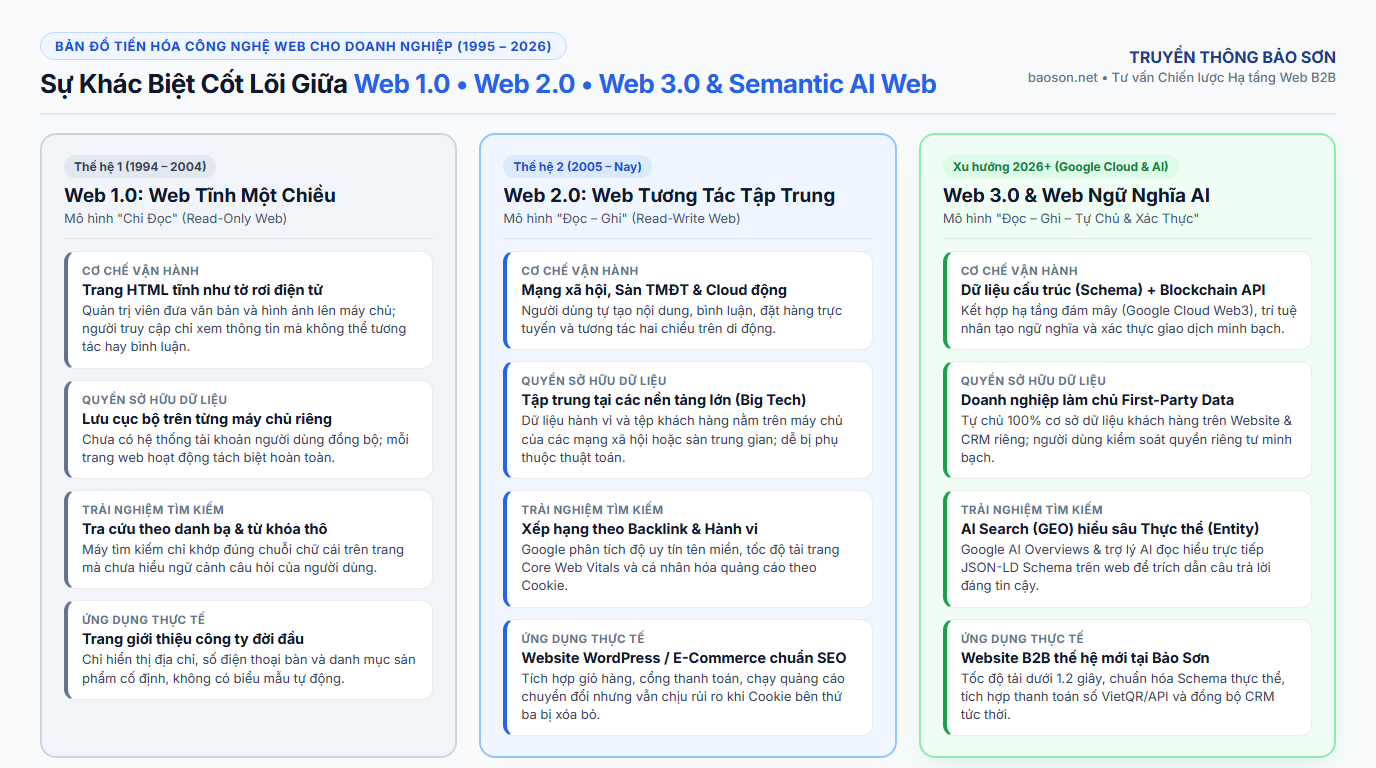
| Comparison Criteria | Web 1.0 (1994 – 2004) One-Way Static Web |
Web 2.0 (2005 – Present) Centralized Interactive Web |
Web 3.0 & Semantic AI (2026+) Semantic Web & Data Autonomy |
|---|---|---|---|
| User interaction model | Read-only: Visitors view fixed text and images like a paper catalog on a screen. | Read and Write (Read-Write): Users comment, text, and place orders on e-commerce platforms and social networks. | Read-Write-Own: Personalized interactions based on real context, identity authentication and direct transactions via API. |
| Customer file ownership | It is virtually impossible to collect viewer online behavioral data. | In the hands of intermediary platforms (Social networks, E-commerce platforms); When the platform squeezes interaction or locks the account, it means losing customers. | First-Party Data autonomous enterprise: Customer data is stored encrypted on the company's own Website & CRM with transparent consensus. |
| How Google reads and ranks content | Counts the raw keyword density that appears in HTML text tags. | Based on Backlinks, time on page and mobile loading speed signals. | Reading and understanding Entity & JSON-LD Schema: Google's AI engine directly extracts price lists, star ratings, and structured answers. |
| Source Code Format & Archive | Static HTML files located on a single, slow physical server. | Dynamic source code (WordPress/PHP/JS) runs on Cloud Hosting but is easily bloated due to installing many third-party tracking codes. | Core Web Vitals standard lightweight architecture: Combines high-speed Cloud NVMe, Server-side Tracking and secure API/Webhook gateway connectivity. |
| Payment Methods & Authentication | Manual transfer at the bank counter or pay in cash. | Domestic/international card payment gateway and e-wallet through intermediaries. | Instant digital payment (Dynamic VietQR / Banking API / Digital Contract): Automatically check orders in seconds without needing to take a screenshot of the bill. |
Why is the giant that dominates Web 2.0 like Google proactively paving the way for Web 3.0?
Google proactively invests in Web 3.0 because search behavior and global data privacy regulations have fundamentally changed: users no longer want to be secretly tracked via third-party Cookies and increasingly prioritize answers with a clear physical origin.
If you look at it on the surface, many people will find it strange: Google is a corporation that benefits greatly from the Web 2.0 model by collecting search data to distribute targeted advertising. Why are they actively building infrastructure for Web 3.0 — which promotes decentralization and data transparency?
From the perspective of longtime web infrastructure and online advertising technicians at Bao Son Communications, this step of Google comes from 3 survival problems:
- The end of the era of tracking with Third-Party Cookies: Personal data protection laws around the world (such as GDPR in Europe) and Decree 13/2023/ND-CP (and the Law on Personal Data Protection in Vietnam) force web browsers to limit silently attaching codes that track users across many websites. Moving to Web 3.0 architecture helps Google build new, more transparent authentication standards.
- The race to provide cloud infrastructure (Cloud Infrastructure): No matter how decentralized a Web 3.0 application or enterprise system is, they still need a powerful cloud server system to operate the network node (Node) and analyze big data (BigQuery). By making the Web3 toolkit available on Google Cloud, Google becomes a "pick and shovel seller" in the new technology revolution.
- The need for Trust & Provenance amid a sea of AI-generated junk content: When anyone can use an AI engine to generate thousands of articles every day, Google's search engine is forced to rely on Web 3.0 and Semantic Web authentication signals — like digital signatures, verified business entities, security certificates, and entity structure data (
Organization,Person,Product) — to know which businesses are truly worthy of high ratings.


Bao Son experts support one-on-one evaluation of UX/UI interface, security, page loading speed and send a quote for the optimal solution for businesses.
What do Small and Medium Enterprises in Vietnam need to prepare for their websites in the Web 3.0 Era?
To adapt to Google's Web 3.0 roadmap in 2026, Vietnamese businesses do not need to invest in complicated cryptocurrencies but need to focus on upgrading 4 core platforms on the website: standardizing JSON-LD Schema semantic data, mastering the original customer data file (First-Party Data), integrating automatic API transaction portals, and strengthening identity security.
Frankly speaking, if your company is doing business in furniture manufacturing, industrial machinery distribution, construction materials, clinics or accounting and legal services in Vietnam, You absolutely do NOT need to spend hundreds of millions of dong to hire a website writer that integrates virtual currency wallets or smart contracts.. Your B2B customers when accessing the website just need to find clear technical information, see transparent quotes, make quick transfer payments and receive immediate advice. What you really need to take away from Google's Web 3.0 revolution is this Semantic Web architecture and The system controls customer data on its own company domain name.
Below are 4 practical items that Bao Son's engineering team is directly implementing SEO standard website design service or restructuring infrastructure for B2B businesses in 2026:
Standardizing the semantic data layer (Semantic Schema JSON-LD) for AI search engines
In the Web 3.0 model, the website not only displays text and images for the reader's eyes, but must have a layer of structured data at the source code layer for computers and artificial intelligence to accurately understand entity relationships. The business website needs to fully declare the entities: Company legal entity (Organization / LocalBusiness with tax code, Google Maps coordinates), Editorial expert (Person), Services/Products (Service / Product with price range AggregateOffer) and Frequently Asked Questions (FAQPage). This is also the core foundation of the method Optimize content for AI search Help your brand get priority citations from Google AI Overviews and ChatGPT.
Build an autonomous customer data warehouse (First-Party Data) right on the Website
As social networks continuously reduce organic display rates and advertising costs become increasingly expensive, the valuable asset of businesses in the Web 3.0 era is the customer data file directly owned by the company (First-Party Data). Instead of leaving customer registration information scattered in email boxes or intermediary platforms, businesses should deploy it Service connecting potential customers with CRM on the website via Server-side Webhook protocol, while integrating a permission-seeking framework to protect personal data transparently in accordance with the law.
Upgrade super-fast storage infrastructure and genuine SSL security identification
A new generation website cannot operate on old Shared Hosting packages that take 5–6 seconds to load the first screen. To meet Google's rigorous Core Web Vitals standards, the source code needs to be placed on the infrastructure High speed NVMe Cloud Hosting service combination of settings Genuine SSL security certificate (DV domain authentication or OV/EV organization authentication) to encrypt the entire transaction data flow between the customer's browser and the company server.

Roadmap and Reference Table for Website Upgrade Categories Ahead of New Standards at Bao Son
At Bao Son Communications, the roadmap to upgrade business websites to meet Google's Semantic Web 3.0 and AI Search standards is divided into 3 practical solution packages with transparent budgets from 2,500,000 VND, implemented quickly in 1 to 5 working days without disrupting business operations.
If your company's current website was built between 2018 and 2022 with an outdated interface on mobile phones or does not have an entity data structure, you can refer to the category allocation table in Professional website upgrade service Below to choose the right step for your budget:
| Deployment Category | Specific Technical Content on the Website | Actual Value Brought to Businesses | Cost & Time Reference |
|---|---|---|---|
| Package 01: Standardize Semantic Data (Semantic Schema & AI Search) |
• Integrated multi-level JSON-LD Schema code set (Organization, Service, Product, FAQPage, BreadcrumbList).• Open controlled access for internal AI search bots robots.txt.• Optimize Heading tag structure and automatic table of contents. |
Help Google's search engine and AI assistants understand the industry, price list, and legal reputation to display outstanding Rich Snippets. | 2,500,000 VND – 4,000,000 VND (Completed in 1 – 2 days) |
| Package 02: Customer Data Autonomy (First-Party Data & API Automation) |
• Connect website form and shopping cart via Server-side Webhook/REST API straight to CRM & Zalo/Telegram. • Configure UTM / GCLID campaign source code capture at the server level. • Integrate dynamic banking QR code payment (VietQR) with automatic confirmation. |
Eliminate dependence on third-party Cookies, shorten customer response speed to less than 3 seconds, and secure customer data files. | 3,500,000 VND – 6,500,000 VND (Completed in 2 – 3 days) |
| Package 03: Comprehensive Restructuring of New Generation Website 2026 |
• Redesign the modern UX/UI interface according to its own brand identity. • Optimize Core Web Vitals page loading speed to reach 90–100 points (< 1.2 seconds). • Includes full set of features in Package 01 and Package 02 + Hands over full rights to the original source code. |
Own B2B digital assets that operate stably, have multi-layer security and are ready to expand API connections in the next 5 years. | From 6,500,000 VND full package (Completed in 5 – 10 days) |
You can check it yourself in 30 seconds by pasting the link to the company's homepage or service page into the tool. Rich Results Test Official Google. If the results show a blank page or only tags WebPage basic but completely lacking legal information Organization, service Service and questions FAQPage, which means your website is still in the old generation — Google's semantic search algorithms are having to "guess" what your website is about!
Frequently Asked Questions As Google Develops Web 3.0 And Impacts Business Websites
Absolutely fine and still the main platform for more than 43% of websites globally. WordPress itself is open source with a very flexible REST API and Webhook architecture, allowing full integration of Semantic Schema JSON-LD structured data, digital payment gateway and cloud data synchronization in accordance with Google's Web 3.0 orientation without having to change to other source code.
It's not possible and it's not necessary. According to current legal regulations of the State Bank of Vietnam, cryptocurrencies such as Bitcoin are not a legal means of payment for domestic goods and services. Businesses in Vietnam should only integrate VietQR automatic transfer payment gateway, legal domestic/international bank cards and apply the semantic data technology layer (Semantic Web) of Web 3.0.
In the Web 2.0 stage, SEO mainly focuses on keyword density and the number of backlinks. Moving to the Web 3.0 stage, AI Search (Google AI Overviews) is combined, the algorithm appreciates the authenticity of the Entity, the author's professional authority (E-E-A-T), the direct answer structure and the transparent JSON-LD Schema data code layer.
When properly implemented by the technical process at Bao Son Communications — keeping the URL structure (Slug), main title tags and core content intact, while adding the JSON-LD Schema layer at the source code layer — current keyword rankings are not only preserved but also increase visibility (Rich Snippets) and are cited on the AI answer box.
You just need to leave your phone number in the registration box below or text the website link directly via Zalo (+84) 987 838 199. Bao Son Communications' engineering team will review Core Web Vitals speed for free, check the entity Schema structure, evaluate SSL security and send a specific recommendation report within 2 working hours.